Showing posts with label miscellaneous. Show all posts

What I learned from reading 1 Samuel

As I keep reading, I get more and more and more into the stories.  This one is one of my favorites so far. Partially because it's political.  I'm a Humanist - so the moral politics and what the moral lessons for politics are intrigue me. Especially since the lessons weren't what I thought they would be given what political Christianity looks like and advocates for in the United States.

Anyway - here are the political lessons of 1 Samuel:
  • Fair and impartial judges are essential to peace among people. (1 Samuel 7)
  • Monarchy’s are against the will of God. (1 Samuel 8)
  • Don’t suppress dissent with violence (1 Samuel 11:13)
  • If you want peace, don’t appoint a man of war to rule over you. (1 Samuel 14) 
  • You get the government you deserve (1 Samuel 12:12)
  • God does not support pre-emptive attacks. (1 Samuel 13) 
  • Sometimes you win by not fighting. (1 Samuel 26)
  • Violence begets violence (1 Samuel 30)
  • Plotting to overthrow a government? Even if you have god on your side, you still need to be a bit sneaky. (1 Samuel 16)

The entire story is one of corruption vs. honesty in governance.  The people want a king. God warns them that kings are bad. They demand a king. God chooses one for them, this is Saul. Turns out - Saul doesn't obey God in quite the right anal retentive way God wants him to and so God starts to plot against Saul by choosing and mentoring David through lots of political maneuvering and fighting. Saul becomes increasingly corrupt in his quest to maintain power and it is this corruption that serves as the moral heart of the story.

What surprised me was that god is pro-judges and basically anti organized government. Not sure how you have judges without a way to pay them, but I guess since at the time the priestly class were the judges, they got paid as part of their priestly duties to the people. That's why they got to keep a portion of all the sacrifices.

Regardless, the preference is clearly for a type of theocratic based self rule.  I'd call it libertarian, except that it's clearly theocratic. Rule by priests/judges - when you need them.  But, there were lots of priests and judges and people were free to follow whichever one they thought most "godly" with individuals really only standing out as good from time to time.

This book also makes the case against nepotism and biological succession. Because whenever someone was godly/goodly - his sons were inevitably not.

The final thing that really shocked me about this story is the homosexual love story between Saul's son Jonathon and David - the king in training. Whatever political Christians try to say about what god thinks about gays - is wrong. They just haven't read this book. 


The story so far

Here is a quick synopsis of the first 7 books of the Bible.

Genesis:

Adam and Eve begat. Their children begat and eventually we come to Abraham who is the father of the Hebrews who eventually come to live in Egypt.


Exodus:

Moses starts a cult and convinces his followers to leave Egypt with him. They go live in the desert for 40 years surviving on Manna.

Leviticus:


Rules are issues. Sacrifices are made. People are killed.

Numbers:

A huge number of religious zealots camp out in the desert and fight amongst themselves for 40 years until they finally decide to go and conquer a neighboring land.

Deuteronomy:

Moses is getting ready to die so we are treated to a recap of his story and his laws.

Joshua:

Joshua, a war monger, takes over. They kill a lot of people, finally settle in Palestine/Israel and then they start fighting amongst themselves.

Judges:


After Joshua, a series of interesting characters rule over Israel, but mostly they are conquered by other people. 

On Snake Handlers

A week or so ago, a snake handling preacher died:

See: http://lauraturner.religionnews.com/2014/02/20/jamie-coots-death-dont-understand/

Snake handlers take their cue from Mark 16:16-18 where it says the truly faithful can handle snakes.  However, like most religious people who quote the Bible, they mostly take that quote out of context. I say mostly because these churches also like to drink poison as a test of faith.

Anyway - here is what Mark 16:16-18 basically says in it's entirety (paraphrased).

 The sign of a true believer and prophet of God is that they can:

  • Cast a devil out
  • Speak in tongues
  • Handle snakes (not necessarily poisonous ones – just snakes)
  • Drink poison and not die, and
  • Lay hands on and actually heal the sick.
These are the 5 things that prove you are truly faithful. 5 things!  You have to do all of these things to prove you have been chosen by God/Jesus to be a spokesperson for Him. . Keep in mind that the writers of this passage state in another section of Mark 16 that they are aware that others can do some of these things too, this is why they require the entire package. If people can do part of this, but not all of this, they are to be considered false prophets.

My point is that groups that handle poisonous snakes as a test of faith are doing it wrong.  They don't have to handle poisonous snakes. That isn't part of the test. At all! Any snake will do. And it's important to remember the context of when this section of the Bible was written. Most people at that time couldn't tell poisonous snakes from non-poisonous ones. To the lay person, they were all the poisonous and dangerous. We know this was a scam that anyone could do because in modern tribal areas - you still have magic men wowing the gullible by handling non-poisonous snakes but leading their audience to believe they are poisonous when they actually aren't. The handler isn't taking any actual risks, but their audience doesn't know that. This was and still is a scam to prove an individual has magical powers and should be feared. Regardless, handling poisonous snakes is NOT part of the criteria listed in Mark 16:16-18. Anyone who thinks it is, isn't reading the passage correctly.

The 2nd thing we should consider is that speaking in tongues is also similarly not impressive. It can be faked.  Casting a devil out - not sure how you would prove you did that. So... again, that's not something I think that would be useful in a modern test of faithfulness per Mark 16:16-18.

Which leaves us with only drinking poison and not being harmed and the healing the sick through the laying on of hands. These are things that in the modern age are still considered impressive and are scientifically verifiable. Which means, they would make a great objective test of whether someone is actually speaking on behalf of Jesus/God or not. And I think we can all agree, taking blind faith out of the equation and replacing it with an objectively verifiable way to know whether any particular religious leader is worth following or not would be nice.

How to apply the Mark 16:16-18 test

Since speaking in tongues and handling snakes and saying you've cast out a demon are things that just about anyone can do or fake, I am proposing a new rule. all prophets or people who claim to speak on behalf of God or Jesus must: 
  • Provide a faith healing through the laying on of hands verified by science as having no medical intervention, and
  • They need to drink actual poison and not be harmed by it. Again this must be done in a controlled setting so it can be properly verified and so that if they are harmed, they can receive immediate medical attention - no option to refuse. There is nothing in Mark 16 that suggests not seeking medical care is noble or a test of faith. All it means is that you weren't chosen by God/Jesus to speak on his behalf. People who profess to be faithful should be humble enough to accept it if they aren't among God's chosen representatives. 
Perhaps the James Randi Educational Foundation can act as the arbitrator of whether a "prophet" or priest meets the test of faith that God/Jesus clearly laid out to help us determine the false prophets from the real.

In conclusion:

Any pompous ass claiming to speak for God should be asked to drink poison in a controlled setting (so that if they get sick they can be saved by medicine). They must also perform a faith healing in a controlled setting. If they refuse or fail this 2 part test, they have to admit they have no right to speak on behalf of God or Jesus per Mark 16. And that they are a false prophet. End of story!

The faithful should demand that any Bible based religious leader who wants to lead them or claims to know God's will, must pass this test! It's reasonable and consistent with Biblical beliefs. They should insist on this test for the same reason the ancients did - so that they won't be led astray by a false prophet.


Post Script:

This test would only need to be administered once per proposed prophet or priest. Once they pass the test, they are cleared. The reason I think Humanists and skeptics should administer the test is

a)  to make sure it is objective and
b) to control it for health and safety reasons. 

There is no reason why any of these dangerous activities should be done in a church without medical supervision. Ever. The additional benefit of having these done in a controlled monitored way is that if someone failed the test, they could not only receive the necessary medical care to recover from the poisoning, but also to help them cope with the emotional and psychological fall out of learning they aren't a chosen representative. I can imagine that for some people, this might come as somewhat of a shock. Maybe the voice in their head they think is god is the devil, or maybe they are just mentally ill. Regardless, anyone who takes the test and fails will need support, compassion and medical assistance as they adjust to the reality that they do not have special supernatural powers conferred on them by God.

No Camels in the Bible

So it turns out that there should have been no camels in the Bible.  Yet there are. There is a prohibition on eating them. They are talked about and used as pack animals on occasion. But according to scholars camels weren't used in the area the events of the Bible take place in until centuries after King David - which is centuries before Moses and Abraham.

See: http://www.nytimes.com/2014/02/11/science/camels-had-no-business-in-genesis.html?smid=fb-share&_r=0

Their conclusion is that these books where written down after these folks knew about camels and so the original stories were changed to include this common pack animal. Seems reasonable.  But then I start to think, they did spend a LOT of time in Egypt.

But then I think, they couldn't possibly have had corn either - that was a new world crop. Unless our history is wrong and that guy from America Unearthed is right.

Regardless, I thought this was cool and related to the study here - so enjoy. 

Lego Tabernacle

crappy crayon drawing of the tabernacle
This is a bonus post - mostly because it's so darned cool.

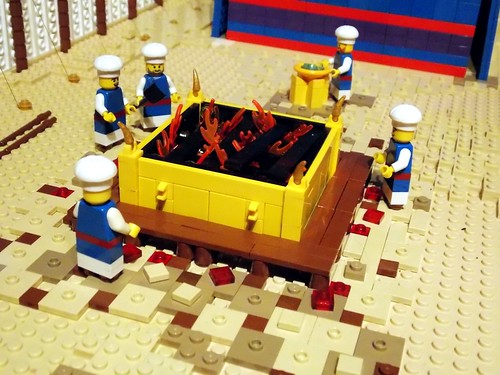
If you've read my analysis of Exodus, you know I LOVE the tabernacle and the way it is described. Someone created a lego version of it - which is way cooler than my crappy crayon drawings.

Here is a link to the entire set of photos: http://www.flickr.com/photos/brickspartan/sets/72157633039628470/

And here are some of the images:
Altar made of brass
The tabernacle complex